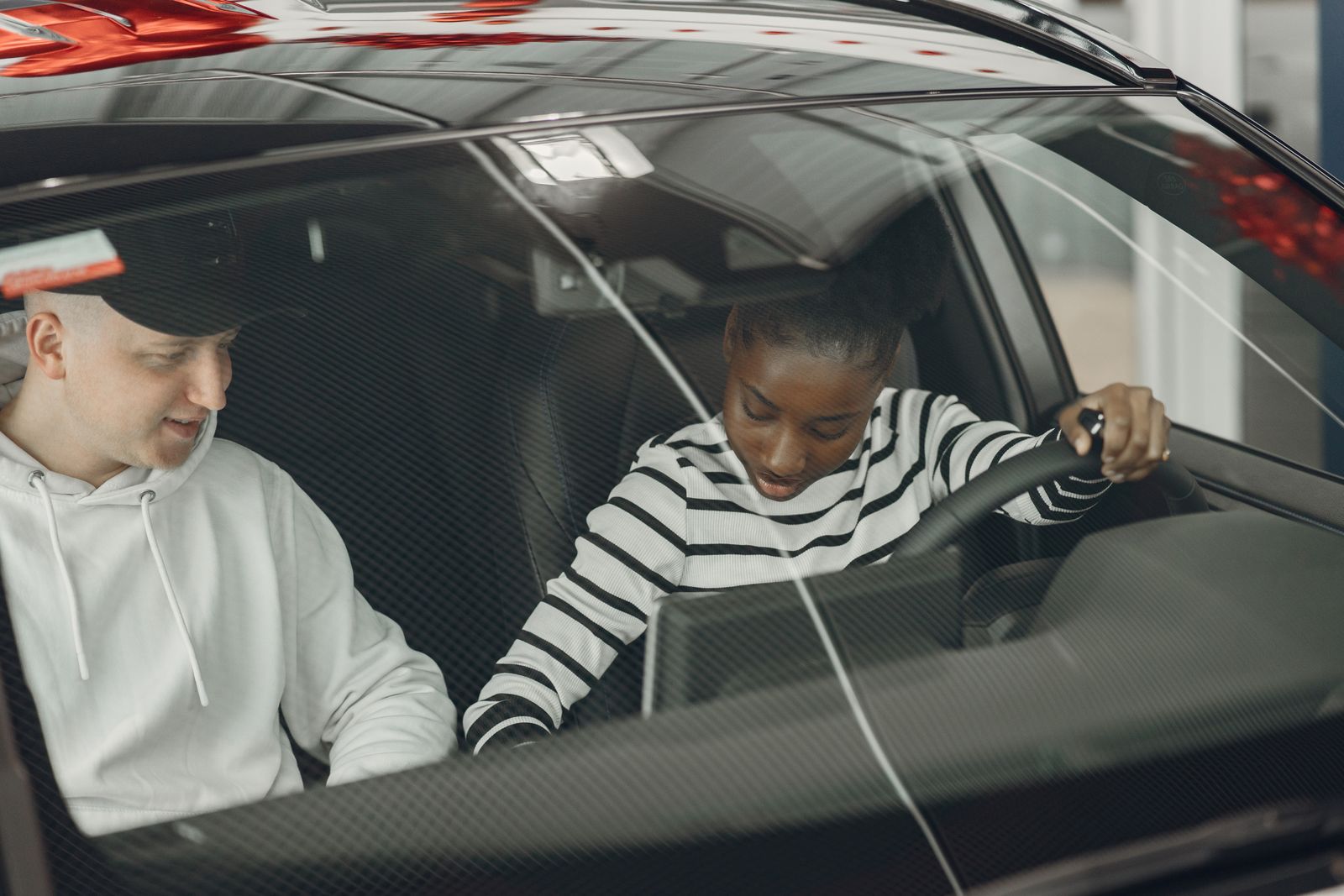
Photo: Gustavo Fring via Pexels
The practical driving test is the last gate before a Swedish licence, and it is the one that costs the most to get wrong. A category B driving test (körprov) is priced separately from the theory test and costs well over twice as much, the fee is charged again for every attempt, and you cannot bring your own car. For anyone who has just passed the knowledge test in English, the useful thing to know is not how hard the driving is. It is which paperwork, which car and which clock decide whether you are allowed to sit the test at all.
Two agencies, two jobs
Sweden splits the licence process between two authorities, and sending a question to the wrong one is a common way to lose a week. Trafikverket, the Swedish Transport Administration, runs the tests: it owns the booking service, takes the payment, employs the examiners (förarprövare) and photographs you for the licence. Transportstyrelsen, the Swedish Transport Agency, is the licensing authority: it grants the learner permit, assesses the medical and personal requirements, decides the rules that govern the tests, and issues the licence itself.
So booking, fees, cancellations and test content are Trafikverket matters. Permits, eyesight certificates, exemptions and the validity of a passed test are Transportstyrelsen matters. The websites are separate too, which is why a search for “book driving test Sweden” that lands you on Transportstyrelsen leaves you no closer to a slot.
What has to be in place before you can book
Three things must exist before a category B driving test can be booked, and all three can expire.
First, a learner permit (körkortstillstånd) from Trafikverket’s counterpart, Transportstyrelsen. Trafikverket states it plainly: you cannot book a test without one. For group 1 categories, which include B, the application needs a self-completed health declaration and a basic eyesight certificate (grundläggande synintyg), and that certificate must not have been issued more than two months before you apply. Many opticians file it digitally. Transportstyrelsen says a permit normally takes up to four weeks once everything has arrived, and longer if anything in the medical or personal assessment needs investigating.
Second, both parts of the mandatory risk education (riskutbildning). Part 1 covers alcohol, drugs, fatigue and other risk behaviour. Part 2 covers speed, safety and driving in varying road and weather conditions, and it is the part that includes the skid track (halkbana). Both must be done before the theory test, not just before the driving test, and they stay valid until the day you collect your licence or for five years at most. A motorcycle risk education does not count for a car.
Third, a passed theory test that is still inside its validity period. If you have not sat it yet, note that the knowledge test can be taken in English and in 14 other languages, and our guide to the Swedish driving theory test in English covers the language choice, the format and the booking. The validity period, though, is about to change.
The clock on your theory test changes on 19 August 2026
Transportstyrelsen has amended the rules. Under TSFS 2026:47, decided on 30 March 2026, a passed knowledge test is valid for one year from the date of the test, and the change enters into force on 19 August 2026. The old rule gave four months. The regulation carries a transitional provision that is easy to miss: knowledge tests taken before the entry into force keep the old wording.
Read that carefully, because the date that decides your window is the date of your theory test, not the date of your driving test. A pass on 18 August 2026 gives you four months to complete the practical test. A pass on 19 August gives you a year. If you are sitting the theory test in the next few weeks and your practical test is likely to be months away, those two days are worth more than any revision.
Letting the window lapse is not cheap to undo. Transportstyrelsen does allow an application for extended validity, but only on special grounds. One example is an illness or serious injury that stopped you taking a retake, and that ground requires a medical certificate. Another is Trafikverket being unable to offer you a retake slot inside the period. The application has to reach the agency before the pass expires, and it carries a fee of 4,000 SEK that is not refunded even if the application is refused. Compare that with the cost of simply sitting the theory test again, and the arithmetic argues for planning rather than applying. Transportstyrelsen has put the scale of the problem at roughly 9,000 people a year passing the knowledge test two or more times, which is what prompted the extension in the first place.
What the test actually consists of
Trafikverket describes the category B driving test as three components: a safety check, specific manoeuvring, and driving in traffic. The time set aside for the test is 45 minutes. The examiner meets you, walks with you to the car, explains how the test will run and how they will direct you, and you drive in both urban and rural traffic. You get the result immediately afterwards. If two examiners get into the car, that is normal: it happens during examiner training and as part of Trafikverket’s own quality work on making tests consistent.
The safety check is where the Swedish vocabulary matters
The test opens with a safety check of the car, and this is the part most candidates underestimate. The examiner gives clear instructions about what to inspect, and Trafikverket lists what can come up:
- lighting, indicators, reflectors and the horn (belysning, körriktningsvisare, reflexer och signal)
- windscreen wipers and washers (vindrutetorkare och spolare)
- steering and brakes (styrning, bromsar)
- tyres and wheel rims (däck och fälg)
- fluids, including washer fluid, coolant and engine oil (spolarvätska, kylarvätska, motorolja)
- warning systems (varningssystem)
If you find a fault you are expected to propose what should be done about it. If some part of the check is physically beyond you, you ask the examiner for help rather than skipping it. And where it is needed for the assessment, the examiner will ask you what should be checked and why. That last sentence is the reason this section is worth rehearsing in Swedish: the drive itself is directions and observation, but the safety check is a short spoken exam about car parts. Learn the Swedish words in the list above and the awkwardness largely disappears. Once you are in the seat, you adjust seat, head restraint, steering wheel, mirrors and belt before anything else.
Manoeuvring, and then the road
The manoeuvring elements are specific and announced. You must show an effective emergency stop, meaning the shortest stopping distance you can manage, performed from at least 50 km/h with the examiner deciding the exact speed and telling you when the element is over. You will park, in a bay or along a kerb, and tell the examiner when you consider it finished. You will reverse, with clear instructions on where and how far. You will start on a slope, turn where told, and move off from the kerbside. You will also be asked to operate a control while driving, for instance switching on the wipers yourself when it starts to rain.
The driving covers urban streets, rural roads that may be narrow, winding or gravel, roundabouts, signalled junctions, level crossings, roadworks and possibly a motorway where the limit can run to 120 km/h. You will be given destinations to reach on your own, some signposted and some not, and if you take a wrong turn you or the examiner can simply turn the car around and continue. Reduced visibility and slippery surfaces are treated as part of the test rather than reasons to postpone it.
Trafikverket is unusually specific about tolerance. Minor errors that are not decisive for road safety are acceptable if they are not repeated too often: forget to indicate out of a roundabout, say so, and remember it next time. A single stall that does not create danger can still pass. Slowing down excessively or sitting in too low a gear in a roundabout, on the other hand, can fail you, because it reads as poor planning. If you fail, you cannot retake the same category the same day.
What it costs, and how the fee is structured
The category B driving test costs 1,000 SEK during the daytime and 1,400 SEK for slots after 6 pm and at weekends. These figures were checked against Trafikverket’s own price list on 30 July 2026. They are national rates and are not set locally, so the same test costs the same in Kiruna and in Malmö. What varies is the time of day you book, not the town.
The theory test, by contrast, is 420 SEK daytime and 520 SEK evenings and weekends, so the practical test is well over twice the price. Do not carry the theory figure over into your budget. Photography taken in connection with a test is a further 120 SEK.
Two details in the price list are worth reading closely. Hiring a car from Trafikverket for a category B test costs 800 SEK, and unlike the test fee itself it does not rise in the evening. So a weekday test in a Trafikverket car comes to 1,800 SEK, and the same test in an evening or weekend slot comes to 2,200 SEK. The second detail is an absence: heavier categories such as BE, C and D have a separate, cheaper fee for retaking only the safety check, and category B does not. Fail any part of a B test and you pay the whole fee again.
The car is not yours to choose
This catches out new arrivals more than any other rule. You may not take the category B driving test in your own car. Trafikverket’s answer is a flat no: only a car from Trafikverket or from an educator may be used. In practice that means either your driving school’s car or a hire car booked with the test, which is what the 800 SEK line covers.
There is one exception, and it is a real one. Candidates with a mobility impairment have the right to take the test in their own adapted car, or in an adapted car from a driving school or upper secondary school. The car does not need dual controls, but it must be roadworthy, taxed, inspected and registered in use, must have approved tyres for the conditions, must weigh no more than 3,500 kg, must be capable of at least 100 km/h, and must have three-point belts and head restraints in the front plus an extra interior mirror for the front passenger. The condition codes in your learner permit have to match the adaptation you actually use, and the examiner checks that first: if they do not match, the test does not happen. Adapted-car tests are booked by telephone on 0771-17 18 19 rather than online, whether you book yourself or your school books for you.
One more consequence of the car rule: if you sit the test in an automatic, your licence carries condition code 78 and is limited to automatics. Moving to manual means a second driving test and a new photograph.
Rebooking, cancelling and simply not turning up
Trafikverket’s booking and cancellation terms are built around a single 24-hour line. Cancel more than 24 hours before the slot and the fee is refunded automatically. Rebook a test that is already paid for and the payment follows you to the new time, with nothing more to pay. Cancel or rebook inside 24 hours and the fee stands.
After that the rules are strict in a way that rewards early arrival. If you do not turn up you pay, and Trafikverket names delayed public transport and traffic queues as examples that do not excuse it. If you are turned away at the desk you also pay, whether the reason is an unacceptable identity document or a mandatory training that has expired. Illness is the one route to a refund, by application with a certificate from a healthcare provider, and Trafikverket adds that turning up ill may get you refused anyway. An unpaid invoice attracts a 50 SEK reminder charge, and candidates under 18 must have paid at least 25 hours before the start or the booking is cancelled automatically.
Trafikverket’s own scheduling advice is sensible and easy to overlook: book the theory test and the driving test on the same occasion, but a few weeks apart, so that there is room to retake the theory test before the practical one if you need to. Automated booking tools and bots are not permitted in the system.
The document that stops more tests than nerves do
Trafikverket states that the most common reason a candidate is not allowed to sit the driving test is an identity document that is not valid, typically one that has expired. The document must be physical, intact and current, and the accepted list is narrower than most people assume:
- a SIS-marked company card, service card or ID card
- a Swedish national ID card
- a national ID card issued by another EU country on or after 2 August 2021
- an ID card issued by Skatteverket, the Swedish Tax Agency
- a Swedish driving licence
- a Swedish EU passport, or another EU passport
- a passport issued by the Faroe Islands, the United Kingdom, Iceland, Liechtenstein, Norway or Switzerland
Look at what is absent. A passport from outside the EU and that short list, an American, Indian, Australian or Brazilian one for example, is not on it. Neither Freja eID nor a digital BankID card is accepted. If you hold a third-country passport and no Swedish ID card, the route is an application for exemption from the identity requirement, in which someone else certifies who you are. That application must reach Trafikverket at least two weeks before the test, the person certifying you has to attend on the day and show their own valid document, and a granted exemption is valid for six months for test purposes. Full details are on Trafikverket’s page for what to do before the test, which also confirms that you should arrive at least 30 minutes early. Applying for a Skatteverket ID card in parallel is usually the calmer option, and it is worth starting before you book anything. A similar list applies earlier in the process, at the optician who issues the vision certificate for your learner permit, but the two lists are not the same. Another EU country’s national identity card counts at the test and not at the optician, and the way round a missing document differs too: at the optician a close relative stands next to you at the identity check, rather than an application sent in two weeks ahead.
One boundary is worth stating because it saves the whole exercise: if you already hold a driving licence issued in another EEA country, you cannot take Swedish theory or driving tests at all. That licence is exchanged at Transportstyrelsen instead, and our guide to foreign driving licences in Sweden sets out which countries can exchange directly and which cannot.
Support, interpreters and adaptation
Here the practical test and the theory test part company, and the difference is easy to get wrong. The support options Trafikverket lists, namely extended time, an oral test and a test with an interpreter, apply to the theory test and the professional tests. For the driving test, what Trafikverket names is a sign language interpreter, arranged by phoning customer services on 0771-17 18 19, and the adapted car described above. If you need either, phone rather than book online, and do it early.
Beyond formal support, Trafikverket encourages something simpler. Nerves before a driving test are described as entirely normal, and you are invited to say so, along with anything else you want the examiner to know about you, before the test starts. For a candidate whose Swedish is still coming along, saying that out loud at the beginning is a better strategy than hoping it will not come up.
Planning beats predicting
You will see pass rates for Swedish driving tests quoted in the press, sometimes broken down by test centre. Treat them with care. Trafikverket’s own licence pages carry no pass rate at all, so any figure you meet has been compiled from Trafikverket data by someone else, and it describes the share of all tests taken at a centre, retakes included, rather than your own chance of passing. A prepared candidate at a low-scoring office is not facing those odds, and a shaky one at a high-scoring office is not protected by them.
What you can control is the sequence. Get the learner permit moving first, since it is the step with a four-week queue and no way to hurry it. Confirm that your identity document will still be valid on the day, and start the exemption or the Skatteverket card early if it will not. Time the theory test with 19 August 2026 in mind, because that date decides whether you have four months or twelve. Then book the practical test in a daytime slot, in a car you have actually driven, and read the safety check list once more in Swedish. If you are still choosing where to learn, the local listings for Stockholm and Malmö, and for every other municipality with approved schools, show which ones operate near you, and the school’s car is the one you will most likely take the test in.
Last fact-checked: 15 August 2026. Last updated: 29 August 2026