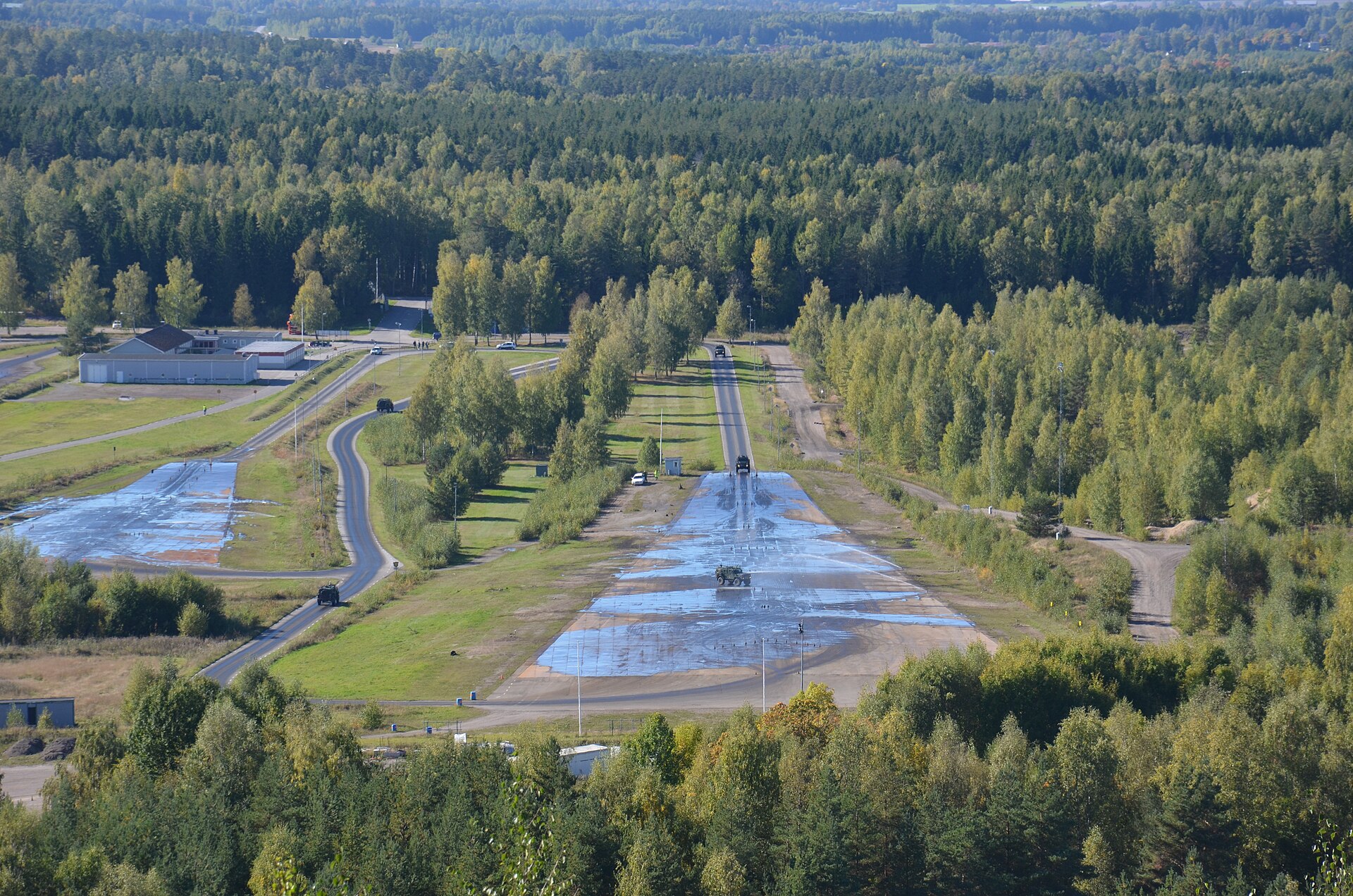
Sweden makes two risk courses compulsory before you are allowed to sit the theory test for a category B licence, and the second one is the hard part to get hold of. Transportstyrelsen’s public register of approved providers lists 942 permit holders for the theoretical part and 82 for the skid pan part. Those 82 are registered in 56 of Sweden’s 290 municipalities, so 234 have no registered provider. Eight operators hold more than one of the 82 registrations, so 70 businesses stand behind them. If you live outside a city, the skid pan booking, not your lessons, decides when you can take the test.
Photo: Bengt Oberger, CC BY-SA 4.0, via Wikimedia Commons
The two courses are called riskutbildning del 1 and del 2 in Swedish, and are usually shortened to Risk 1 and Risk 2. Del 2 is also called halkbanan, the skid pan. A driving licence test may be taken only once both have been completed, under the Driving Licence Act.
Norrköping has seven of the 82, Stockholm County four
The skid pan providers cluster hard. Norrköping alone has seven of the 82, Jönköping has four and Gothenburg three, while the whole of Stockholm County has four. Counted by county, Västra Götaland has ten and Östergötland nine. Eleven of the 21 counties have three or fewer in the register, and Blekinge, Halland and Jämtland one each.
For the theoretical part there are 942 approved providers, roughly eleven for every one that may run the skid pan. That gap is the practical reason to book Risk 2 before anything else in your schedule. Sitting through three hours of theory can be arranged almost anywhere; getting a slot on a skid pan within reasonable travelling distance cannot.
You can search the register yourself by permit type and county in Transportstyrelsen’s list of approved training providers. Pick “Riskutbildning B, del 2” to see the skid pan holders.
Risk 1 covers alcohol and fatigue, Risk 2 braking from 70 km/h
Risk 1 covers alcohol, other drugs, fatigue and other risky behaviour behind the wheel. Risk 2 covers speed, safety and driving in difficult conditions, and it is where the skid pan comes in. The split is set in Transportstyrelsen’s regulations on risk training for category B.
Each part must run for at least 180 minutes excluding breaks. A session may hold at most 16 students, and during the practical elements of Risk 2 there may be no more than four students per instructor. At Stora Holm in Gothenburg, Risk 1 takes 3 hours 30 minutes and Risk 2 4 hours 15 minutes including breaks.
Risk 2 is not a demonstration you watch. The syllabus requires you to perform effective braking from at least 70 km/h on a high-grip surface, to adapt your driving to a given situation and to use the seat belt correctly. The surface itself is regulated: the friction between tyre and skid surface must be such that maximum braking from between 45 and 70 km/h gives a stopping distance of around 80 metres.
Risk 2 has to wait until the final stage of your driver training
The regulation contains one timing rule. When Risk 2 begins, the student must be in the final stage of driver training. Stora Holm tells students in English that coming too early means not passing, because the course requires advanced driving skills: managing heavy deceleration, adjusting speed to the task and manoeuvring the car safely.
Nothing in the regulation forces Risk 1 to come before Risk 2, and both Gillinge and Stora Holm sell them on the same day as a package. What limits you is your own driving level, not the order of the two parts.
Each part stays valid for five years, and the provider reports it
A completed risk course, or a completed part of one, is valid for five years under the Driving Licence Ordinance. It also expires the day your licence is issued, so a course taken for a category B licence does not carry over to anything else. Motorcycle risk training does not count towards a car licence either.
Reporting is the provider’s job, not yours. Under Transportstyrelsen’s regulations on risk training it must happen immediately once a student has completed the course. Before reporting, the instructor must have checked your identity, so bring ID.
For the theory test, Trafikverket requires both parts to be done and the training to be valid on the day you turn up. Turning up without it costs you the fee, since the test is charged per attempt.
Course prices are set by the provider, test fees are not
Nothing regulates what a risk course costs, and prices differ between providers. Gillinge in Vallentuna, one of the four skid pan registrations in Stockholm County, listed Risk 1 from 499 SEK and Risk 2 from 1 690 SEK on its English booking page in September 2026. Same-day packages are sold at a separate price.
The test fees are national. Trafikverket charges 420 SEK for the category B theory test during the day and 520 SEK for slots after 6 pm and at weekends, and 1 000 SEK and 1 400 SEK respectively for the driving test. Photography in connection with a test is 120 SEK. Renting a car for the driving test through Trafikverket costs a further 800 SEK.
The register records no language, so ask the provider about English
The register records the permit holder’s name, address, telephone number and permit type. It records nothing about the language of instruction, and it only lists providers who have consented to publication. So the language question has to be settled with the provider before you pay.
Gillinge and Stora Holm both answer it on their own websites. Gillinge sells both parts in English, including a combined day and a version with a bus from Uppsala. Stora Holm in Gothenburg runs its risk education in English and accepts a student bringing an interpreter, provided you say so when you book. Elsewhere, ask, and ask specifically about Risk 2, where instructions are given while you are driving.
The theory test is different: it exists in 15 languages including British English, you choose the language when you book, and you can switch to Swedish mid-test. An interpreter can be applied for, and the test time for category B then rises to 100 minutes. Our guide to taking the Swedish theory test in English goes through the booking and the format. For the driving test, the only language arrangement Trafikverket publishes is a sign language interpreter, arranged through its customer service on 0771 17 18 19. Our guide to booking and passing the practical driving test covers it.
Risk training from another EEA state can count
If you have already done equivalent risk training in another EEA state, you may credit it towards the Swedish requirement. The rule is in the Driving Licence Ordinance and has applied since 2009. Transportstyrelsen decides whether the foreign course is equivalent, so this is an application, not something you can assume. It is worth checking before you pay for both parts again.
If you already hold a licence restricted to automatic transmission and take a driving test to lift that restriction, the risk training requirement does not apply to that test.
In which order should you book Risk 1, Risk 2 and the tests?
Apply for your körkortstillstånd first, since no test can be booked without one. Then find your nearest Risk 2 provider and book the date, because that date is the scarcest thing in the process. Fit the lessons and Risk 1 around it, and book the theory test once both parts are reported. If you book in that order, your timetable is built around the skid pan date instead of being delayed by it.
Both parts are described by Transportstyrelsen on its page about riskutbildning för personbil, and the rules for sitting the tests are on Trafikverket’s page for behörighet B, the category B licence. If you are still choosing a school, our guide to finding a driving school in Sweden that teaches in English explains what the school arranges for you and what you have to book yourself.
Provider counts are from Transportstyrelsen’s register as of 24 September 2026. County figures follow the register’s own county classification. The register gives each permit holder’s registered postal address, which need not be the address of the skid pan itself, and it lists only providers who have consented to publication, so the true number of sites may be higher.
Last fact-checked: 24 September 2026