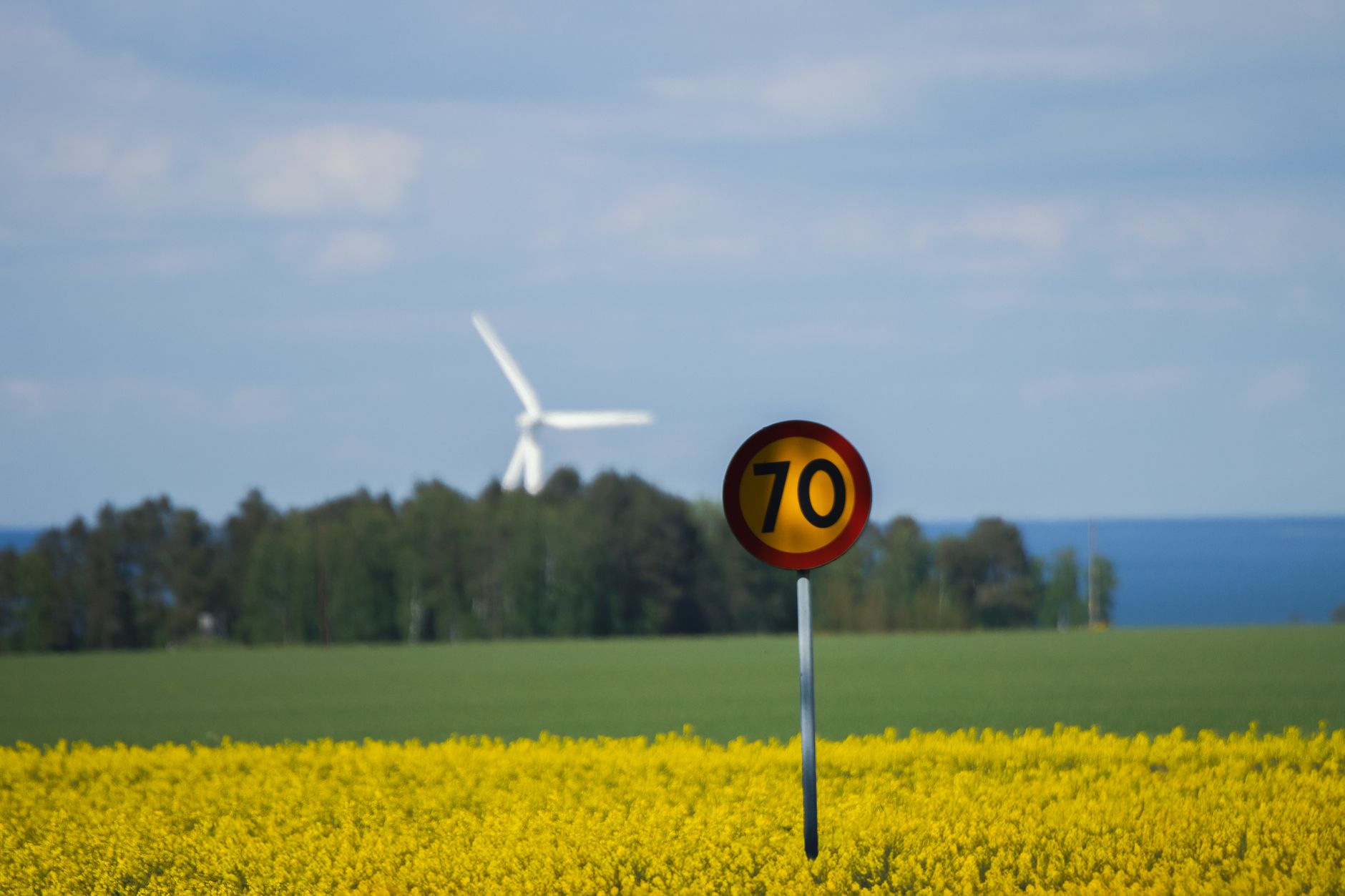
Photo: Efrem Efre via Pexels
Most of what you already know about driving transfers to Sweden intact. Traffic keeps to the right, the signs are the familiar European shapes, and someone who has commuted by car for a decade somewhere else will not feel lost on a Swedish road. The trouble is concentrated in a small number of rules that look like the ones back home and are not.
Seven of them account for most of the surprises: giving way to the right, entering a roundabout, speed limits that are never posted, when the lights have to be on, the alcohol limit, winter tyres and the phone in your hand. All but one carry a fixed price, set nationally and printed in a catalogue the officer at the roadside reads from, and the amounts are listed further down. The alcohol limit is the exception, because breaking it is a crime rather than a fine.
Give way to the right, including in the car park
The rule most likely to cost a newly arrived driver money is högerregeln. Where the paths of two vehicles cross and nothing else settles the question, you give way to the vehicle approaching from your right. It sits in the traffic ordinance, not on a sign.
Drivers from countries where priority at a minor junction is normally decided by markings tend to read an unmarked crossing as a place where nobody has priority. In Sweden it is decided, and the Swedish Transport Agency is unusually explicit about how far the rule reaches: it applies everywhere, including three-way junctions, car parks and other open areas, and off-road terrain as well. A supermarket car park in Sweden is a grid of unmarked junctions with a live priority rule running through it.
What overrides it is what you would expect. Give-way and stop signs, traffic lights, joining a main road, entering a roundabout. One exception is easier to miss, and it sits exactly where the rule bites hardest: coming onto a road from a car park, a property, a petrol station or a similar area, you have a duty to give way to every vehicle whose course crosses your own, not only to the ones approaching from the right. Bicycles count as vehicles in Swedish law, so the rule governs them too, and giving way means slowing or stopping in good time and moving off only when you can do so without danger or obstruction.
Roundabouts have a rule, not a convention
In several countries the priority at a roundabout depends on what the entry is signed with. In Sweden the question never reaches the signpost. A driver entering a roundabout gives way to every vehicle already circulating, and that is written into the ordinance itself. Traffic runs anticlockwise around the island.
You will encounter a great many of them. The Transport Agency notes that roundabouts have become steadily more common in Sweden, mainly because they are safer than ordinary junctions and move traffic better. That is good news, because the rule is the same at every one of them.
The limit is 50 or 70 unless a sign says otherwise
Sweden does not sign every speed limit, because two of them apply without a sign at all. Inside a built-up area the limit is 50 km/h. Outside it, the base limit is 70 km/h. Both figures are in the ordinance rather than on the roadside.
From there the numbers move in both directions. A municipality may lower the limit inside a built-up area to 30 or 40 km/h, and the Swedish Transport Administration may set 80, 90, 100 or 110 km/h on a particular road, or 120 km/h on a motorway. An unsigned road, though, is never a road without a limit, and assuming otherwise has an on-the-spot price attached.
A second duty runs alongside the number. Speed has to be adapted so that you can stop within the stretch of road you can see and before any obstacle you can foresee, which in practice means the posted limit is a ceiling and not a target on a dark forest road in November.
Lights stay on, and the trap is at the back
Sweden requires a vehicle’s prescribed lights to be lit whenever it is driven on a road, at any hour of the day and any time of year. That rule is often summarised abroad as compulsory dipped headlights around the clock, which is a shade off. In daylight a car may use daytime running lights, fog lamps or a reduced-voltage dipped beam instead, and the ordinance insists on the dipped beam proper in darkness, at dawn and dusk, and when the weather calls for it.
The trap sits behind you. On many cars the daytime running lights at the front come on by themselves while the rear lights stay dark, and in daylight that is perfectly legal. The Transport Agency spells out the consequence on its page on vehicle lighting: when it gets dark, or foggy, or snowy, you have to make sure the dipped beam and the rear and side lights are genuinely lit, and on some cars that means reaching for the switch yourself. Swedish winter afternoons turn dark early enough that this happens on the way home from work rather than late at night.
The alcohol limit is a criminal threshold, not a tolerance
Drink driving in Sweden begins at 0.10 milligrams of alcohol per litre of exhaled air, which the police put at roughly 0.2 per mille in the blood. It is a crime rather than a fixed penalty: the sentence for rattfylleri is a fine or up to six months in prison. From 0.16 milligrams per litre the licence is taken there and then, and the Transport Agency decides afterwards whether to revoke it. At 0.50 milligrams, about 1.0 per mille, the offence becomes grovt rattfylleri and carries up to two years.
A driver who is under the influence and has presented a considerable danger to road safety can be reported for the aggravated offence without having reached 0.50 milligrams per litre at all.
Winter tyres follow the weather, not the date
Between 1 December and 31 March a car must be fitted with winter tyres or equivalent equipment when there are wintry road conditions. The dates on their own do not trigger the requirement, and neither does the weather on its own outside those dates.
Wintry road conditions, vinterväglag, means snow, ice, slush or frost on any part of the road, and it is the police who decide whether they apply on the road you are driving on. In wintry road conditions the tread has to be at least 3 mm.
The tyres may be studded or unstudded, and unstudded winter tyres have to carry the three-peak-mountain-and-snowflake marking, except on trailers with a total weight up to 3.5 tonnes, where tyres made for winter road conditions and marked M+S are accepted until 30 November 2028. Studded tyres are allowed from 1 October to 15 April, and outside that period whenever winter conditions apply or are expected, but a car may not run studded and unstudded tyres at the same time.
Three details matter particularly to people who have just arrived. The requirement applies to foreign-registered vehicles exactly as it does to Swedish ones, which the Transport Agency states directly in its English guidance on winter tyres. A vehicle whose model year in the vehicle register is 30 years or older falls outside the requirement altogether, an exemption that has applied since 1 June 2019. And heavy lorries and heavy buses keep a calendar of their own: their requirement runs from 10 November to 10 April, whether or not the road is wintry. All three paragraphs, including the 1 December rule for cars, sit in the same chapter of the ordinance.
The phone stays out of your hand
Two separate things sit inside the phone rule. A driver may use a phone or similar equipment only where doing so does not impair the driving of the vehicle, and may not hold the device in the hand. A cradle and a voice command stay inside the rule; a glance at a message resting in your palm does not.
What each mistake costs
Swedish fines for everyday traffic offences are neither discretionary nor local. The Prosecutor-General sets a national catalogue of on-the-spot fines, ordningsbot, published in the statute book. The figures below are from the catalogue’s schedule for offences against the traffic ordinance and apply to the driver of a motor vehicle. They have been in force since 1 November 2025.
| Offence | Fine |
|---|---|
| Not giving way to a vehicle approaching from the right | 2,000 SEK |
| Not giving way when entering a roundabout | 2,000 SEK |
| No winter tyres in wintry conditions, 1 December to 31 March | 2,000 SEK |
| Holding a phone or other communication device while driving | 1,500 SEK |
| Driving without the prescribed lights in poor light or visibility | 1,200 SEK |
| The same in daylight | 500 SEK |
| Up to 10 km/h over a limit of 50 km/h or lower | 2,000 SEK |
| Up to 10 km/h over a limit above 50 km/h | 1,500 SEK |
| 36 km/h or more over any limit | 4,000 SEK |
The same 10 km/h over the limit costs 2,000 SEK where the limit is 50 km/h or lower and 1,500 SEK where it is higher, so the cheaper offence is the one committed on the faster road. From those amounts the fine climbs with every five kilometres an hour to a ceiling of 4,000 SEK.
Which licence you may drive on here
How long the licence already in your wallet lasts here depends first of all on whether it was issued in the EEA.
A licence issued in an EEA state is valid in Sweden for as long as it is valid in the country that issued it and has not been exchanged for a Swedish one, and it stays valid after you register as resident here. There is no clock on it. A licence from outside the EEA works differently: it is valid only while you have not been a registered resident in Sweden for more than one year. Licences from the United Kingdom and the Faroe Islands keep working however long you have been registered here, and the Transport Agency can grant an exemption from the one-year limit in individual cases, but only where you are staying in Sweden for a limited period and the exemption carries no risk to road safety. Outside the EEA, exchange for a Swedish licence without tests is open only to holders of licences from the United Kingdom, the Faroe Islands, Switzerland and Japan.
Two conditions attach to the document itself. A licence laid out to neither the Geneva nor the Vienna convention model, and not made out in English, German or French, is valid here only together with a certified translation into English, German, French, Swedish, Danish or Norwegian, or an international driving permit. A licence with no photograph on it is valid only together with photo identification. The Transport Agency sets out the whole picture in English under licences issued abroad, and we have gone through the categories, the deadlines and the paperwork in our guide to holding a foreign driving licence in Sweden.
If the answer is that you have to obtain a Swedish licence, the rules above are also the syllabus. They come back in the knowledge test, which can be sat in English and which we cover in a separate guide to the theory test in English, and they come back again in the car, where the examiner is watching how you handle exactly these junctions during the practical driving test. Finding an instructor who can explain a Swedish roundabout in a language you follow under pressure is a separate problem, and there is a way to go about it.
Common questions
Does the right-hand rule apply in a car park?
Yes. The Transport Agency states that the rule applies everywhere, and names car parks and other open areas alongside ordinary junctions, along with off-road terrain. Where two vehicles’ paths cross inside a car park and no sign or marking says otherwise, the one on the right has priority. Driving out of the car park onto a road is the other way round: there you give way to every vehicle whose course crosses your own.
Do I need winter tyres in November?
Not in a car. The requirement for passenger cars, light lorries, light buses and their trailers runs from 1 December to 31 March, and only when there are wintry road conditions. Heavy lorries and heavy buses are a different matter: their requirement starts on 10 November and runs to 10 April regardless of the weather.
Can I drive in Sweden on a licence issued outside the EEA?
You may drive on it for up to one year from the day you are entered in the Swedish population register, provided it is valid in the country that issued it and has not been exchanged. Two conditions attach to the document itself: a licence that follows neither the Geneva nor the Vienna convention model and is not made out in English, German or French is valid only together with a certified translation or an international driving permit, and a licence without a photograph is valid only together with photo identification. After that year it stops being valid here, with licences from the United Kingdom and the Faroe Islands as the exceptions, and the Transport Agency may grant an individual exemption for a stay of limited duration. Of licences issued outside the EEA, only those from the United Kingdom, the Faroe Islands, Switzerland and Japan can be exchanged for a Swedish one without tests.
Are the fines the same everywhere in Sweden?
For the offences in the on-the-spot catalogue, yes. The amounts are set nationally by the Prosecutor-General and published in the statute book, so the fine for entering a roundabout without giving way is the same in Kiruna as in Malmö. What is decided locally is the speed limit, not the price of exceeding it.
Last fact-checked: 9 October 2026