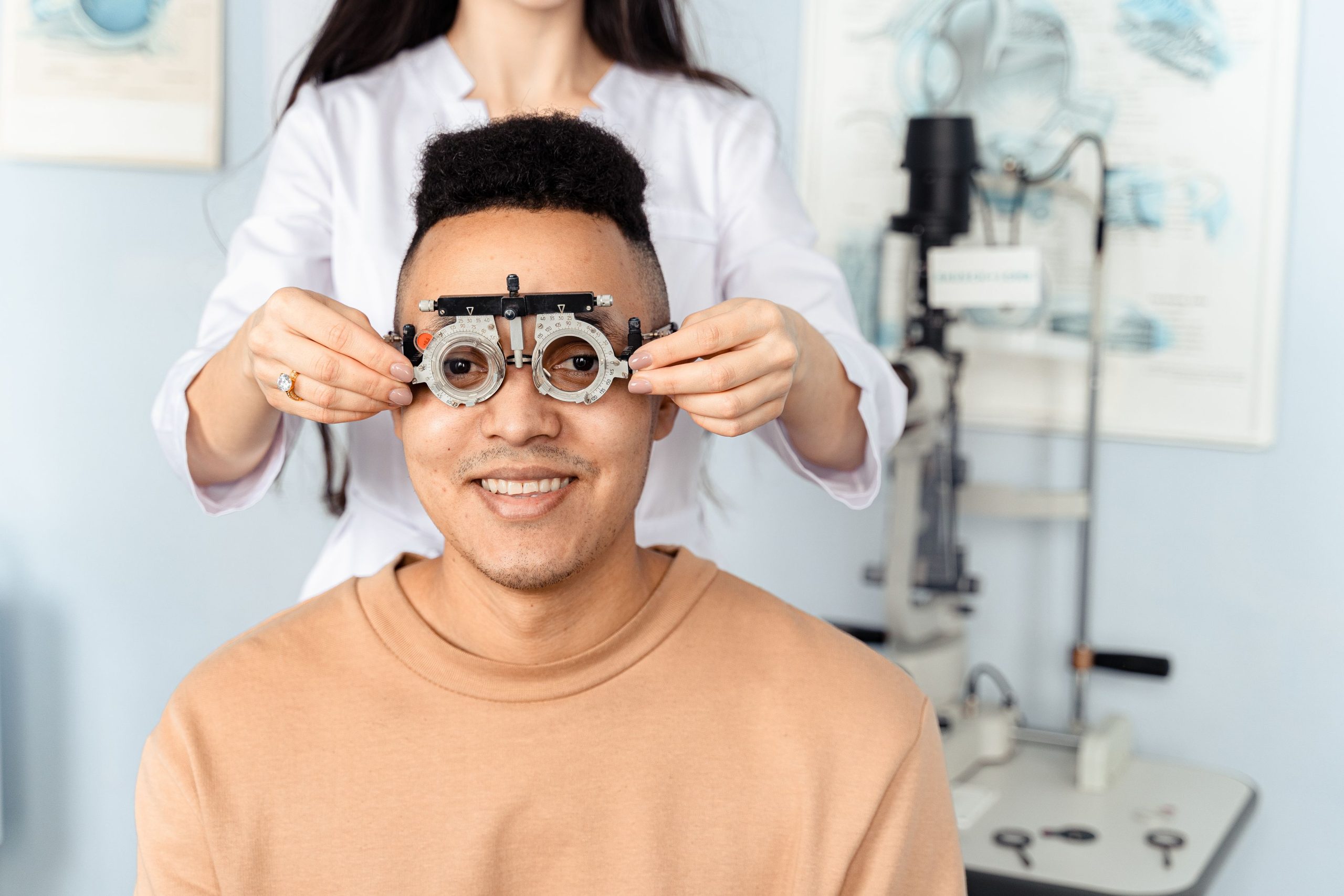
You had your eyes tested at home a few months before the move, the optician said everything was fine, and now the Swedish application for a learner’s permit asks for a synintyg. It is a fair hope that the test you already paid for will cover it.
That test will not cover it, and the reason is worth a minute. Sweden is not asking for an eye test result. It is asking for a certificate on its own form, signed by a licensed optician or doctor, and issued no more than two months before you apply. So book a new appointment once you are here. Your test at home still helps, because you already know roughly where your eyesight sits against the Swedish threshold and whether you will be driving with glasses noted on the licence.
Photo: Adventure Studio via Pexels
Who signs the certificate, and when
The document is the grundläggande synintyg, the basic vision certificate, and everyone who applies for a körkortstillstånd (learner’s permit) has to send one to Transportstyrelsen, the Swedish Transport Agency. Since 1 February 2025 only a licensed optician or doctor may issue it. Before that date driving schools could run the test, along with several other trained roles, so older guides and forum threads still describe a route that has closed.
Your optician has two ways to deliver it. Many opticians can report it digitally through Transportstyrelsen’s e-service, which needs a Swedish mobile BankID at their end, and the certificate then reaches the agency without passing through your hands at all. The alternative is the paper form, which goes in with your application. Either way the certificate must be issued within two months before you apply, so there is little point booking the appointment the week you land if the application is still months away. You sign a health declaration yourself in the same application, and applying for the permit costs nothing.
What you have to be able to see
For a category B car licence your visual acuity is measured with both eyes open, and glasses or contact lenses count towards the requirement. If you need correction to get there, that becomes a condition printed on the licence, and the same basic certificate is what you use later if your eyesight changes enough to have the condition removed.
| What the rule covers | What applies for category B, and for AM, A1, A2, A, BE and tractor |
|---|---|
| Visual acuity | At least 0.5 with both eyes used together, read at 4 to 6 metres |
| Glasses or contact lenses | Allowed, and recorded as a condition on the licence |
| Field of vision | At least 120 degrees wide and 40 degrees tall, with at least 50 degrees to each side and 20 degrees above and below the centre |
| When the field is actually tested | Only when the basic certificate leaves the agency unable to decide |
The appointment itself is shorter than most people expect. The only equipment required is what it takes to measure visual acuity, and the rest is questions: eye disease, reduced vision, and anything in your history that might affect how you see, such as a stroke, laser treatment for retinopathy, a head injury or a premature birth. Lorry and bus categories are stricter, at 0.8 in the better eye and 0.1 in the weaker one, but nothing above the car licence applies to a category B applicant.
The field of vision, and when anyone measures it
The width rule in the table is a genuine requirement, yet it is not tested at your appointment. A field examination happens only when the answers on the basic certificate leave Transportstyrelsen unable to decide whether you meet the requirements. You are then asked for an utökat synintyg, an extended certificate with an Esterman field test attached. An optician has been able to carry that out as well since February 2025; it used to be work for an eye specialist.
The same reform loosened the field limits themselves. A degree of reduced light sensitivity is now accepted, at a level Transportstyrelsen deliberately set close to Norway and the United Kingdom, after roughly 1,000 people a year had lost a licence on field grounds under the older Swedish limits.
Which ID the optician will accept
At the examination you have to prove who you are, and the list of accepted documents is short and closed: a SIS-marked ID card, a Swedish national identity card, an ID card issued by Skatteverket (the Swedish Tax Agency), a Swedish driving licence, an EU passport, or a passport from the Faroe Islands, the United Kingdom, Iceland, Liechtenstein, Norway or Switzerland. A residence permit card is not on that list, and neither is a passport from outside that group, so an American, Indian, Australian or Brazilian one will not get you through the door.
If the optician already knows you by name and face and can establish your identity anyway, no document is needed at all. A close relative, meaning a parent or guardian, a spouse, a cohabiting or registered partner, or an adult child, may instead certify your identity in writing, but that person has to attend the identity check and show an accepted document of their own. Failing both, apply for an ID card from Skatteverket, open to anyone aged 13 or older who is registered in the Swedish population register and has a personnummer, whatever their citizenship. It takes a paid application and a booked visit to a service centre, so start it early.
Trafikverket, the agency that runs the driving tests, asks for identification at the practical test too, from a list that is close to the optician’s without being identical. It also accepts a national identity card issued by another EU country on 2 August 2021 or later, which the optician cannot go by. The way round a missing document differs as well: Trafikverket wants a written application for an exemption at least two weeks before the test, and the person vouching for you still has to be there on the day and show valid identification of their own.
If you are mapping out the whole route, our guides to booking and passing the practical test and to taking the theory test in English cover the stages after the permit, and there is a separate guide to finding a driving school that teaches in English.
FAQ
I am exchanging a foreign licence rather than taking a new one. Do I still need this?
For a car licence from an EU or EEA country, no. That exchange asks for the application form and your original licence, and a vision certificate enters the picture only for lorry and bus categories, and then only in some cases. An exchange from the United Kingdom, the Faroe Islands, Japan or Switzerland works differently: for the car and motorcycle categories you order a health declaration and an eyesight certificate to send in with the application. Which countries may exchange at all, and on what terms, is covered in our guide to foreign driving licences in Sweden.
Can my optician back home fill in the Swedish form?
No, book the appointment once you are in Sweden. A licensed doctor or optician has to certify the information on a form Transportstyrelsen provides, the appointment includes an identity check against the list above, and the digital route to the agency runs through a Swedish e-service that needs Swedish mobile BankID. Nothing in the rules lets you hand in an eye test result issued in another country instead.
I was refused a licence on field of vision grounds before February 2025. Do the new limits reach me automatically?
No. To have your case assessed against the current limits you have to apply for a learner’s permit again. Nothing reopens on the agency’s own initiative.
How long is the permit good for once I have it?
Five years, and it cannot be extended. It covers every category in its group, so a permit taken out for a moped licence still works if you decide on a car licence three years later, provided it has not run out. Normal processing takes up to four weeks, and longer if anything in the medical assessment needs looking into.
Last fact-checked: 9 October 2026