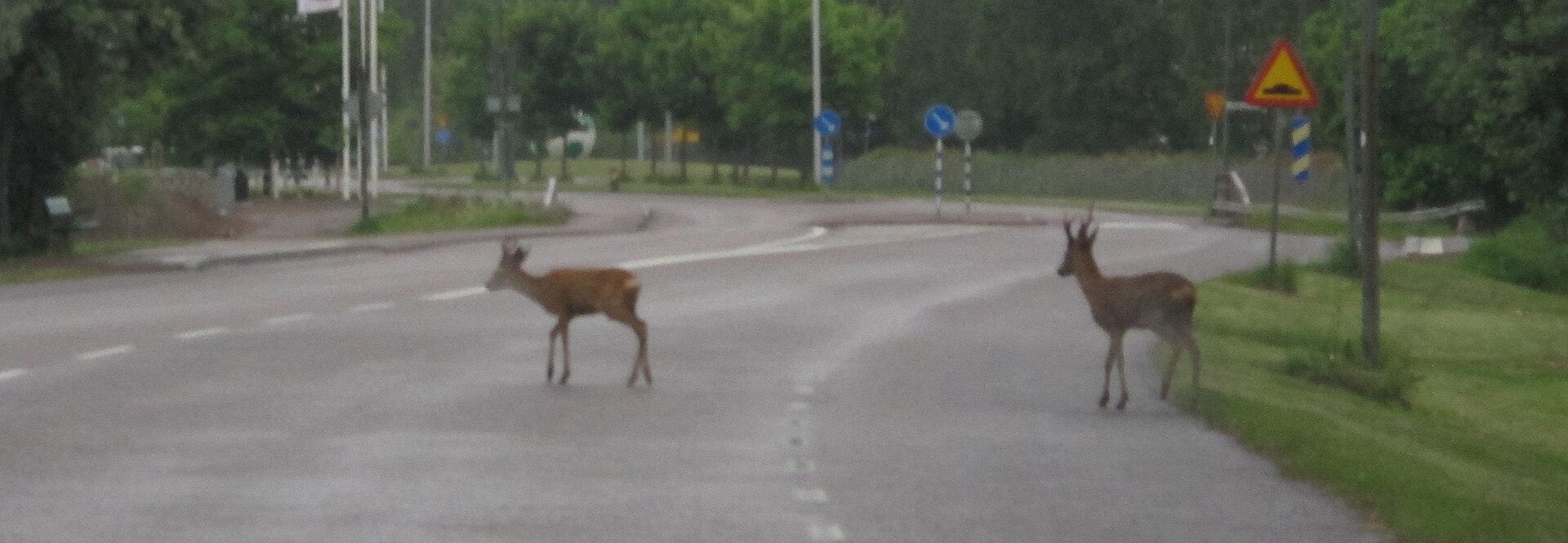
Call 112 now and ask for the police, even if the deer ran into the trees and nobody is hurt. In Sweden you must mark the place of the collision and tell the police as soon as possible after hitting a moose, a deer or nine other species. The police say the duty applies even when the animal does not look injured. The police then contact a hunter with special skills to track the animal. The operator who answers speaks English.
What to do after hitting a deer or moose, step by step
- Stop where it is safe and switch on the hazard lights. If the car could endanger or block other traffic where it stands, move it to a suitable spot straight away. If someone has been killed or seriously injured, move the car only if it is a danger to other traffic. Put out the warning triangle if other drivers need to be warned.
- Check whether anyone in the car is hurt. If someone is injured, say so first when you call. The police send a patrol to the scene when a person has been injured.
- Call 112 and ask for the police. The police ask drivers to use 112 for these collisions. The 112 operator speaks Swedish and English and can bring in an interpreter if needed.
- Give the details the police need. Have these ready:
- your name and personal details
- the car’s registration details
- the place (the nearest town or village, the road number, a landmark and a GPS position if you can get one)
- which animal it was
- whether the animal is still there, or which way it went
The 112 app from SOS Alarm, for iPhone and Android, shows your coordinates.
- Mark the spot on the side of the road where the animal disappeared. A special marking strip is handed out at vehicle inspection stations and police stations, and some new cars come with one. Without a strip, use something that is easy to see, such as a plastic bag or a scarf.
- Do not follow the animal into the forest. Leave the search to the hunter the police call in.
- Keep your phone switched on for a while afterwards. The hunter may call you for more details about the place.
Do I have to call the police if the animal ran off?
Yes. The duty to mark the spot and call the police applies even when the animal is not visibly injured, and also when it lies dead at the scene. An animal that runs off can still be badly hurt, and the marked spot shows the hunter where to start.
Animals often survive the collision or are never found. The National Wildlife Accident Council (Nationella viltolycksrådet) recorded 72,384 animals involved in collisions on Swedish roads in 2025. After the search, 15,382 of them were judged unharmed. Another 13,519 were never found, including 3,430 that were judged to be injured.
Which animals must be reported in Sweden?
The duty covers 11 species: bear, wolf, wolverine, lynx, moose, deer, roe deer, otter, wild boar, mouflon and eagle. In the law, deer means red deer and fallow deer. The animal British English calls an elk is the one known in Sweden as älg and in North America as a moose.
Reindeer must be reported too, even though they do not count as wild game.
Roe deer make up most of the animals involved: 49,214 of the 72,384 in 2025. Moose accounted for 5,586.
Already driven on? Call 112 as soon as you can
The rule requires you to act as soon as possible, so call now rather than leaving it. Describe the place as exactly as you can, with the road number, the nearest town and the distance to something you remember passing.
How the Swedish rule differs from British law
In Great Britain the duty to stop covers certain domestic animals, not wild ones. Under the Road Traffic Act 1988, a driver must stop after an accident that injures another person or damages another vehicle, roadside property or an animal. In the Act, “animal” means horse, cattle, ass, mule, sheep, pig, goat or dog. Deer are not on the list, so hitting a deer on a British road does not on its own trigger that duty. In Sweden it is the wild species that must be reported.
SOS Alarm, which answers 112, says the number is for emergencies and that non-urgent police matters go to 114 14. For a collision with one of the 11 species, the police still ask you to call 112, and to do it straight away.
What happens if you do not report it
Failing to report a collision with one of the 11 species is an offence. Under section 45 of the Hunting Act (jaktlagen), a driver who intentionally or through gross negligence fails to report can be fined. Minor cases carry no liability. The Hunting Act penalty also does not apply where the same conduct is punishable under the Swedish law on certain traffic offences instead.
The accident rules in the Swedish traffic ordinance also apply. A road user involved in a traffic accident must stay at the scene and help anyone injured as far as they can. If someone has been injured and the injury is more than minor, the road user must also tell the police as soon as possible.
Tell the owner if the car is rented, leased or from work
The 112 call is about the animal. It does not report the damage to the car to anyone else. If the car belongs to a rental firm, a leasing company or your employer, tell the owner about the collision as well.
November evenings bring the most collisions
In 2025, 9,275 animals were involved in collisions on Swedish roads in November, more than in any other month. A third of them, 3,090, were hit between 4pm and 7pm. A smaller peak came between 6am and 8am, with 1,427.
The police advise drivers to take wildlife warning signs seriously and to be extra careful at dawn and dusk. Sweden also requires dipped headlights in darkness and at dawn and dusk; the rules on lights are in our guide to Swedish traffic rules.
A guide in Swedish to reporting a wildlife collision is on our sister site Körskola.nu.
Last fact-checked: 24 November 2026