DrivingSchool

Category: Driving Licence Rules

  • Eye test for a Swedish driving licence: does a test from abroad count?
    Eye test for a Swedish driving licence: does a test from abroad count?

    You had your eyes tested at home a few months before the move, the optician said everything was fine, and now the Swedish application for a learner’s permit asks for a synintyg. It is a fair hope that the test you already paid for will cover it.

    That test will not cover it, and the reason is worth a minute. Sweden is not asking for an eye test result. It is asking for a certificate on its own form, signed by a licensed optician or doctor, and issued no more than two months before you apply. So book a new appointment once you are here. Your test at home still helps, because you already know roughly where your eyesight sits against the Swedish threshold and whether you will be driving with glasses noted on the licence.

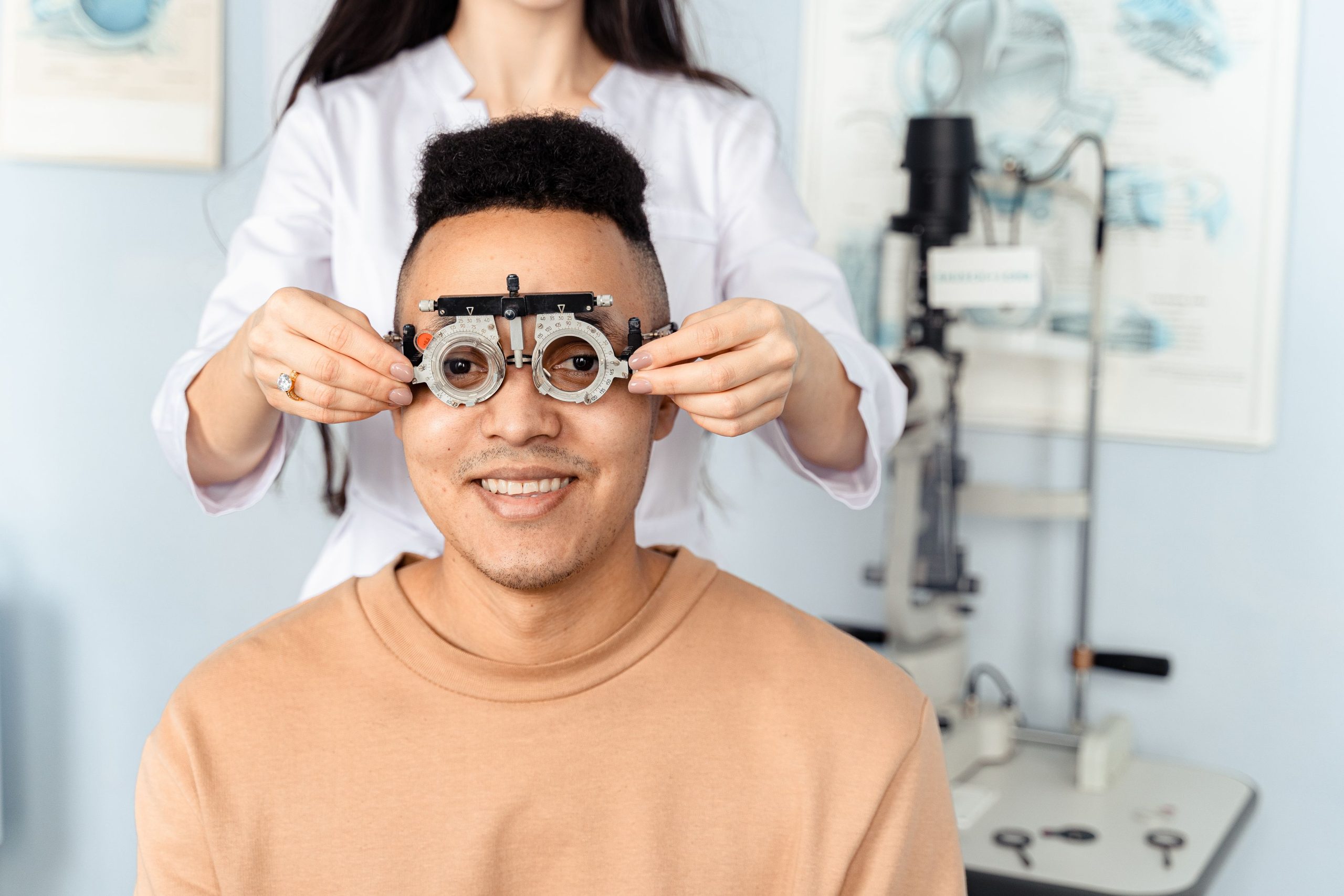
    Photo: Adventure Studio via Pexels

    Who signs the certificate, and when

    The document is the grundläggande synintyg, the basic vision certificate, and everyone who applies for a körkortstillstånd (learner’s permit) has to send one to Transportstyrelsen, the Swedish Transport Agency. Since 1 February 2025 only a licensed optician or doctor may issue it. Before that date driving schools could run the test, along with several other trained roles, so older guides and forum threads still describe a route that has closed.

    Your optician has two ways to deliver it. Many opticians can report it digitally through Transportstyrelsen’s e-service, which needs a Swedish mobile BankID at their end, and the certificate then reaches the agency without passing through your hands at all. The alternative is the paper form, which goes in with your application. Either way the certificate must be issued within two months before you apply, so there is little point booking the appointment the week you land if the application is still months away. You sign a health declaration yourself in the same application, and applying for the permit costs nothing.

    What you have to be able to see

    For a category B car licence your visual acuity is measured with both eyes open, and glasses or contact lenses count towards the requirement. If you need correction to get there, that becomes a condition printed on the licence, and the same basic certificate is what you use later if your eyesight changes enough to have the condition removed.

    What the rule covers What applies for category B, and for AM, A1, A2, A, BE and tractor
    Visual acuity At least 0.5 with both eyes used together, read at 4 to 6 metres
    Glasses or contact lenses Allowed, and recorded as a condition on the licence
    Field of vision At least 120 degrees wide and 40 degrees tall, with at least 50 degrees to each side and 20 degrees above and below the centre
    When the field is actually tested Only when the basic certificate leaves the agency unable to decide
    Source: Transportstyrelsen’s medical requirements for driving licences.

    The appointment itself is shorter than most people expect. The only equipment required is what it takes to measure visual acuity, and the rest is questions: eye disease, reduced vision, and anything in your history that might affect how you see, such as a stroke, laser treatment for retinopathy, a head injury or a premature birth. Lorry and bus categories are stricter, at 0.8 in the better eye and 0.1 in the weaker one, but nothing above the car licence applies to a category B applicant.

    The field of vision, and when anyone measures it

    The width rule in the table is a genuine requirement, yet it is not tested at your appointment. A field examination happens only when the answers on the basic certificate leave Transportstyrelsen unable to decide whether you meet the requirements. You are then asked for an utökat synintyg, an extended certificate with an Esterman field test attached. An optician has been able to carry that out as well since February 2025; it used to be work for an eye specialist.

    The same reform loosened the field limits themselves. A degree of reduced light sensitivity is now accepted, at a level Transportstyrelsen deliberately set close to Norway and the United Kingdom, after roughly 1,000 people a year had lost a licence on field grounds under the older Swedish limits.

    Which ID the optician will accept

    At the examination you have to prove who you are, and the list of accepted documents is short and closed: a SIS-marked ID card, a Swedish national identity card, an ID card issued by Skatteverket (the Swedish Tax Agency), a Swedish driving licence, an EU passport, or a passport from the Faroe Islands, the United Kingdom, Iceland, Liechtenstein, Norway or Switzerland. A residence permit card is not on that list, and neither is a passport from outside that group, so an American, Indian, Australian or Brazilian one will not get you through the door.

    If the optician already knows you by name and face and can establish your identity anyway, no document is needed at all. A close relative, meaning a parent or guardian, a spouse, a cohabiting or registered partner, or an adult child, may instead certify your identity in writing, but that person has to attend the identity check and show an accepted document of their own. Failing both, apply for an ID card from Skatteverket, open to anyone aged 13 or older who is registered in the Swedish population register and has a personnummer, whatever their citizenship. It takes a paid application and a booked visit to a service centre, so start it early.

    Trafikverket, the agency that runs the driving tests, asks for identification at the practical test too, from a list that is close to the optician’s without being identical. It also accepts a national identity card issued by another EU country on 2 August 2021 or later, which the optician cannot go by. The way round a missing document differs as well: Trafikverket wants a written application for an exemption at least two weeks before the test, and the person vouching for you still has to be there on the day and show valid identification of their own.

    If you are mapping out the whole route, our guides to booking and passing the practical test and to taking the theory test in English cover the stages after the permit, and there is a separate guide to finding a driving school that teaches in English.

    FAQ

    I am exchanging a foreign licence rather than taking a new one. Do I still need this?

    For a car licence from an EU or EEA country, no. That exchange asks for the application form and your original licence, and a vision certificate enters the picture only for lorry and bus categories, and then only in some cases. An exchange from the United Kingdom, the Faroe Islands, Japan or Switzerland works differently: for the car and motorcycle categories you order a health declaration and an eyesight certificate to send in with the application. Which countries may exchange at all, and on what terms, is covered in our guide to foreign driving licences in Sweden.

    Can my optician back home fill in the Swedish form?

    No, book the appointment once you are in Sweden. A licensed doctor or optician has to certify the information on a form Transportstyrelsen provides, the appointment includes an identity check against the list above, and the digital route to the agency runs through a Swedish e-service that needs Swedish mobile BankID. Nothing in the rules lets you hand in an eye test result issued in another country instead.

    I was refused a licence on field of vision grounds before February 2025. Do the new limits reach me automatically?

    No. To have your case assessed against the current limits you have to apply for a learner’s permit again. Nothing reopens on the agency’s own initiative.

    How long is the permit good for once I have it?

    Five years, and it cannot be extended. It covers every category in its group, so a permit taken out for a moped licence still works if you decide on a car licence three years later, provided it has not run out. Normal processing takes up to four weeks, and longer if anything in the medical assessment needs looking into.

  • Foreign driving licence in Sweden: EU/EEA, third country rules and the exchange deadline

    Foreign driving licence in Sweden: EU/EEA, third country rules and the exchange deadline

    Photo: Daniel Moqvist via Unsplash

    Moving to Sweden with a driving licence from another country raises a practical question fast: can you just keep driving on it, or does it need to become a Swedish one at some point. The answer splits cleanly along one line. A licence from an EU or EEA country never has to be exchanged. A licence from anywhere else has a clock running from the day you register as a resident, and only two countries are exempt from it. A rule that took effect on 1 May 2026 then added a further condition for EEA licences that started life outside the EEA.

    EU and EEA licences: no exchange required

    If your driving licence was issued in an EU or EEA country, you can simply carry on using it in Sweden. Transportstyrelsen, the Swedish Transport Agency, treats it as valid for as long as it remains valid in the country that issued it, with no requirement to swap it for a Swedish card. Exchanging it is possible if you want a Swedish licence for convenience, but for someone who has moved from Germany, Poland or Ireland, keeping the original card is the simpler route and carries no deadline pressure. If you do exchange, the application asks for the form and your original licence. A vision certificate enters the picture only for lorry and bus categories, and then only in some cases.

    Licences from outside the EEA: the one-year rule

    A driving licence issued outside the EU and EEA works differently. Once you become folkbokförd, the Swedish population register entry that marks permanent residency, the foreign licence is valid for at most one year from that date, unless it was issued in the United Kingdom or the Faroe Islands. After the year runs out, the licence stops being valid for driving in Sweden. There is no automatic Swedish test built into that deadline: if you have not exchanged the licence or obtained a Swedish one by then, you simply lose the right to drive on it, and starting from scratch with a Swedish learner’s process is the fallback.

    The one-year window is therefore the real planning horizon for anyone arriving with, say, a Canadian, South Korean or Brazilian licence. It is worth checking the current process on Transportstyrelsen’s own page on foreign driving licences as soon as the move date is set, since a late start can mean missing the window entirely.

    Which four countries can exchange without a Swedish test

    A licence issued in the United Kingdom, the Faroe Islands, Switzerland or Japan can be swapped straight for a Swedish one, with no Swedish knowledge test and no Swedish driving test. Licences from every other country outside the EEA cannot be exchanged at all, which leaves their holders with the ordinary Swedish route.

    The one-year clock does not treat the four the same way. A British or Faroese licence keeps working in Sweden however long you have been registered as a resident, so nothing forces an exchange and you can carry on driving on the original card indefinitely. A Swiss or Japanese licence stops being valid one year after registration, exactly as any other third-country licence does, and the exchange application has to be in before that year is up.

    For car and motorcycle categories the application asks for a health declaration and an eyesight certificate alongside the application form, your original licence and a certificate confirming that the licence is still valid. That last certificate comes from the authority that issued the licence, or from the Japanese embassy in Stockholm for a Japanese one, so a Swiss or Japanese holder should request it months rather than weeks before the year runs out.

    New rule from 1 May 2026: EES licences of third-country origin

    The rule that changed on 1 May 2026 targets a specific and previously exploitable route. Some people held a driving licence from outside the EEA, moved to another EEA country long enough to exchange it there for an EEA licence, and then used that EEA licence to get a Swedish one without ever sitting a Swedish test, a pattern Transportstyrelsen and the Swedish government describe as körkortsturism, or driving licence tourism. Since 1 May 2026, Transportstyrelsen can refuse to exchange an EEA-issued licence for a Swedish one if its holder cannot show that the licence traces back to genuine competence rather than a paperwork route around the system.

    In practice, an EES licence with third-country origin can still be exchanged for a Swedish licence, but only if one of three conditions is met.

    • The licence was issued after the holder passed both the knowledge test and the practical driving test in an EEA country, rather than simply being swapped in.
    • The original licence, before any EEA exchange, was issued in the United Kingdom, Switzerland, Japan or the Faroe Islands, the same four countries covered by Sweden’s direct-exchange agreements above.
    • The holder had held a licence with the equivalent category, issued in one or more EEA states, for at least five years before becoming permanently resident in Sweden. Five years on the original third-country licence does not count.

    If none of the three applies, Transportstyrelsen can turn down the exchange application, and the holder is referred back to the ordinary Swedish process instead: booking the theory test and the practical test through Trafikverket like any other new applicant. This is a real, current stoppregel, not a proposal. It follows a sharp rise in exchange applications built on EEA licences originally issued outside the EEA, most commonly Romania, and it took legal effect after a government bill on the issue passed through the Riksdag.

    Sitting the tests in English rather than Swedish

    Anyone who ends up needing to take a Swedish test, whether because the one-year window on a third-country licence has closed or because none of the three May 2026 conditions apply, does not have to sit it in Swedish. The knowledge test is available in English at Trafikverket’s own test centres, and the format, question count and pass mark are covered in our separate guide to taking the driving theory test in English, which also explains how the practical test booking works alongside it. The learner’s permit that comes before both tests needs a vision certificate on Transportstyrelsen’s own form, and an eye test taken abroad does not stand in for it.

    A Swedish-language guide for the same situation

    Everything above concerns the specific expat angle: an internationally issued licence and a move to Sweden as an adult. Readers who want the parallel Swedish-language coverage of moving to Sweden and sorting out a driving licence, aimed at a slightly broader newcomer audience, can turn to our sister site körskola.nu and its guide Körkort för nyanlända. The two guides cover the same territory from different angles rather than duplicating each other, so reading both fills in details that a single article would have to compress.

    Where this leaves most readers

    For the majority of people moving to Sweden with an EU or EEA licence, none of this changes daily life: the licence keeps working with no exchange and no deadline. It is specifically the smaller group holding an EEA licence that itself began life as a third-country licence, or a genuinely non-EEA licence past its one-year mark, where the rules above decide what happens next. Given how narrowly the 1 May 2026 conditions are drawn, anyone in that position is better off checking their own case against Transportstyrelsen’s current guidance directly rather than assuming an older description of the rules still holds, since this is exactly the kind of requirement that has just been tightened.

    Driving schools in Stockholm, Gothenburg and Malmö that teach in English are used to fielding exactly these questions from newly arrived clients, and are a reasonable first stop if a licence situation looks unclear before booking any test.